 EN
EN AI, GPT-5 and the Human Factor: The New Balance in ERP Implementations
Artificial Intelligence is at the center of corporate conversations, not just because of the hype, but because it has started delivering concrete results.
Artificial Intelligence is at the center of corporate conversations, not just because of the hype, but because it has started to deliver concrete results.
The Gartner IT Symposium/Xpo™ 2025 brought an emblematic figure: 95% of AI projects still fail to generate ROI, and only one in five achieves measurable success (Gartner, 2025).
But the problem is not the technology — it is our human readiness to use it with purpose and method.
Gartner reinforces that the biggest challenge for AI today is not technical, it is organizational. Companies already master the tools, but still lack leadership, governance, and intentionality.
The report points out that 91% of high-maturity organizations already have a dedicated AI leader, and these are precisely the ones that reap sustainable results.
The conclusion is clear: technological readiness is ahead of human readiness, and the true value of AI only emerges when both evolve together (Gartner, 2025).
This reasoning connects directly to the analysis by Cheryl Strauss Einhorn, published in the Harvard Business Review (In times of uncertainty, ask these questions before making a decision, May/2025). She reminds us that in volatile scenarios, good decisions are born from good questions, such as:
"What decision made today will still make sense a year from now?"
"What if it's not a storm, but the new normal?"
These questions work as clarity and purpose filters, helping leaders avoid reactive decisions and build strategic resilience. Applied to the AI context, it means: before investing in technology, you need to question whether people and processes are ready to extract value from it.
When humans and AI work best together
The MIT Sloan School of Management adds another essential layer. In its study "When Humans and AI Work Best Together, and When Each Is Better Alone" (Feb/2025), researchers analyzed 106 experiments comparing humans, AI, and combinations of the two.
The conclusion is fascinating:
- Humans + AI tend to outperform humans alone;
- But not always better than AI alone;
- Maximum performance happens when each part does what it does best.
In other words: collaboration only generates value when it is intentional and designed. Humans should focus on context, empathy, and judgment; AI on volume, repetition, and analysis.
For the world of ERP implementations, this perspective is crucial. AI can automate artifacts, reports, and analyses, but business understanding and people management remains the human differentiator that ensures project success.
GPT-5 and the era of augmented decision-making
GPT-5, from OpenAI, marks a turning point in this integration. With combined engines of fast and deep reasoning, the model behaves like a cognitive partner, capable of understanding multiple variables and providing support for complex decisions.
In corporate projects, GPT-5 has helped leaders and PMOs analyze risks, identify bottlenecks, and optimize deliveries with agility and context, expanding human capacity without replacing it.
But, as the MIT Sloan study warns, this only generates sustainable results when the collaboration process is redesigned to get the best out of each part.
AI + methodology: the foundation of Oracle projects at Taking
At Taking, we believe that technology only delivers value when it goes hand in hand with method and governance. That's why our implementations follow Oracle's official methodologies:
🔹 Oracle Unified Method (OUM): applied in Oracle Fusion Cloud and E-Business Suite projects, structured in the Inception, Elaboration, Construction, Transition, and Production phases. With AI support (TATe AI), each stage becomes smarter and better documented: Automated generation of artifacts, reports, and schedules; Risk prediction based on historical data; Prioritization and scope control suggestions; Automatic recording of decisions and lessons learned.
🔹 SuiteSuccess: For Oracle NetSuite, it combines leading market practices and pre-configured models, accelerating go-live. TATe AI analyzes adherence, maps gaps, and generates automated tests, ensuring speed without compromising quality.
Another differentiator of Taking is the use of TATe AI, our proprietary platform. All meetings are recorded and automatically transcribed, turning into:
- Smart meeting notes
- Continuous improvement insights
- Living knowledge bases
This reduces information loss, increases transparency, and transforms every interaction into collective learning, exactly the type of human readiness that Gartner describes as essential.
From theory to practice: CAPSUL BRASIL
Recently, we implemented Oracle NetSuite ERP for a major manufacturer in the pharmaceutical, nutraceutical, and cosmetics sector, CAPSUL BRASIL. The company was in accelerated expansion and needed flexibility, scalability, and agility, three attributes that legacy systems rarely offer together.
CAPSUL BRASIL faced a scenario of rapid growth limited by inadequate technological infrastructure. Operations needed to handle multiple sectors, each with distinct regulations and critical traceability requirements. Strategic decisions depended on outdated reports, which compromised agility and precision.
The solution was to implement Oracle NetSuite ERP in the SuiteSuccess version with Financials and Manufacturing modules, led by Taking with full TATe AI support. The SuiteSuccess methodology uses consolidated best practices from similar companies around the world, which accelerates implementation, reduces unnecessary customizations, and delivers faster ROI.
With NetSuite and TATe AI, CAPSUL achieved real-time visibility over finance, production, and inventory — all integrated and up to date. Processes that used to take days now happen in hours. Full traceability allows auditing of each batch, component, and step, ensuring regulatory compliance. The system went from being a limitation to becoming an enabler: the company now scales without having to rebuild its structure at every new level. Strategic decisions moved from "guesswork" to being based on reliable data.
And perhaps most importantly: the company implemented the ERP before it desperately needed to. This strategic decision avoided the chaos that happens when growth outpaces structure and prepared operations for the next challenges instead of just putting out fires.
This case illustrates in practice what the three studies converge in pointing out:
Harvard Business Review: good questions lead to good decisions: before choosing NetSuite, the manufacturer asked the right question: "What decision made today will still make sense a year from now?" The answer was clear: invest in scalability, not in a stopgap.
MIT Sloan: AI and humans deliver more when they collaborate with clear role definition: TATe AI took care of volume, repetition, and analysis (artifacts, tests, transcriptions). Humans focused on context, business, and people (change management, specific adaptations, governance).
Gartner: without human readiness, technology generates no value: the implementation was successful because there was dedicated leadership, clear governance and intentionality in the use of AI, not just "doing it because everyone else is doing it".
AI with purpose and security
The TATe AI (taking.com.br/tate-ai) was developed to combine AI, governance, and data security in a client-segmented environment. The knowledge base is built from official Oracle documentation and real field experience, avoiding common hallucinations and ensuring contextualized and reliable responses.
In other words, TATe AI doesn't just answer, it understands the business.
We believe the future of Oracle implementations will be defined exactly by this balance: prepared people, solid methodologies, and AI applied with purpose and security.
Want to talk about how to apply AI in a strategic, secure, and integrated way with the OUM and SuiteSuccess methodologies?
Talk to a specialist to explore new possibilities for collaboration between humans and artificial intelligence.
Related content
Agentic AI in Practice: What's Changing in the CIO's Role
Agentic AI is redefining the role of the CIO. Beyond task automation, the challenge is to orchestrate people, AI agents, context, and governance to build smarter, more... Read more.
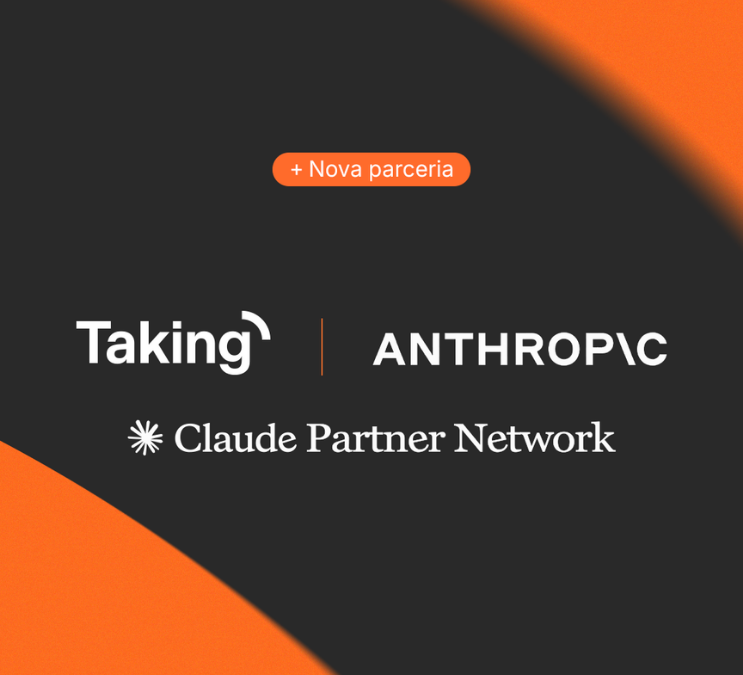
Claude Partners Network - Anthropic and Grupo Taking
We have integrated Claude into our ecosystem and TATe AI, with a goal of having 100 certified consultants by the end of 2026. Learn more about the partnership and what it delivers.

In the competition for IT talent, the job opening is no longer the focal point.
Taking has repositioned its Talent division to place the person, not the job opening at the center. Learn about the strategy that combines experience, business intelligence, and AI.